Guide to Anti-Graffiti Laminate for Printed Panels
Your brand’s visual identity is often only as resilient as the protective film shielding your outdoor displays from the elements. It’s incredibly frustrating to invest in high-quality Dibond or Foamex printing only to find it defaced by tagging or dulled by relentless UV exposure within weeks. You know that first impressions are everything, yet the reality of urban vandalism often leads to expensive, repeated replacement costs that drain your budget and damage your professional reputation.
By integrating high-performance anti-graffiti laminate for printed panels, you can secure your assets against permanent damage and ensure your brand integrity remains uncompromised for years. This strategic investment provides the peace of mind that comes from knowing your signage is built to withstand the British climate and the challenges of high-traffic areas. We’ve mastered the precision of large format protection so you don’t have to worry about the longevity of your prints.
This guide explores the technical specifications of various protective coatings, the chemistry that allows for effortless cleaning, and how these laminates preserve the original colour and quality of your work. You’ll discover how to extend the lifecycle of your national signage campaigns whilst maintaining a pristine professional image through every season.
Key Takeaways
- Learn how to distinguish between standard over-laminates and professional-grade barriers to ensure your signage remains pristine.
- Discover why choosing the right anti-graffiti laminate for printed panels is essential for protecting rigid media like Dibond and Foamex from permanent tagging.
- Master the correct cleaning techniques and chemical agents required to remove vandalism without compromising the integrity of your original print.
- Evaluate the long-term financial benefits of protective coatings by comparing initial investment against the high cost of frequent signage replacement.
- Understand the technical performance differences between PET and Fluoropolymer films to select the most resilient solution for the British climate.
Understanding Anti-Graffiti Laminate for Printed Panels
Anti-graffiti laminate for printed panels isn’t a luxury; it’s a structural necessity for any signage exposed to the public. Think of it as a transparent, high-performance barrier that stands between your brand and the elements. While standard over-laminates offer basic protection against scuffs or moisture, they often fail when faced with solvent-based inks. Spray paint and permanent markers bond to standard films, making removal nearly impossible without ruining the graphics underneath. Specialist anti-graffiti coatings are engineered differently, providing a surface that refuses to let contaminants take hold.
Investing in this technology represents a proactive strategy for asset management. In urban environments, it’s a matter of when, not if, your displays will be targeted. By applying this protective layer at the point of manufacture, you ensure that the vibrant colours of your vinyl printing remain as striking as the day they were installed. It’s about maintaining precision and reliability in your visual communication, regardless of the surrounding environment.
The Chemistry of Protection: How It Works
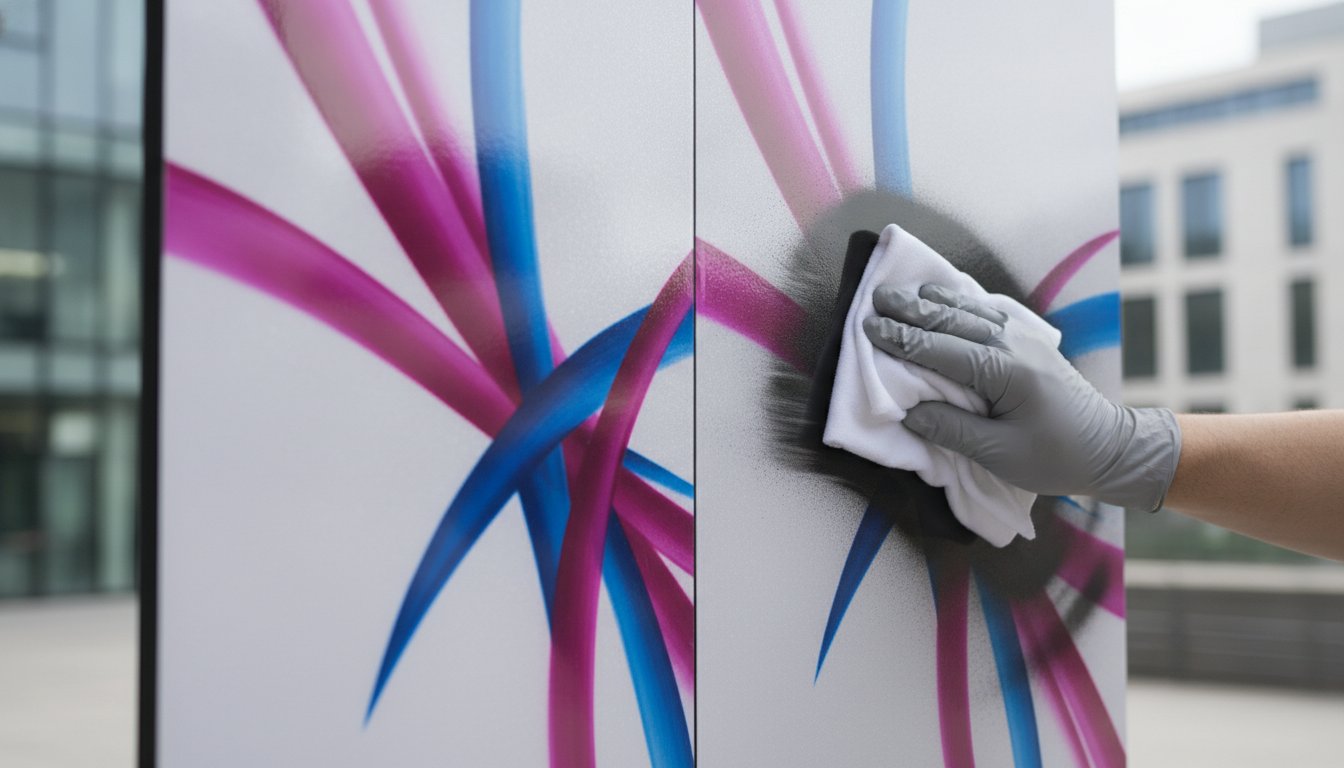
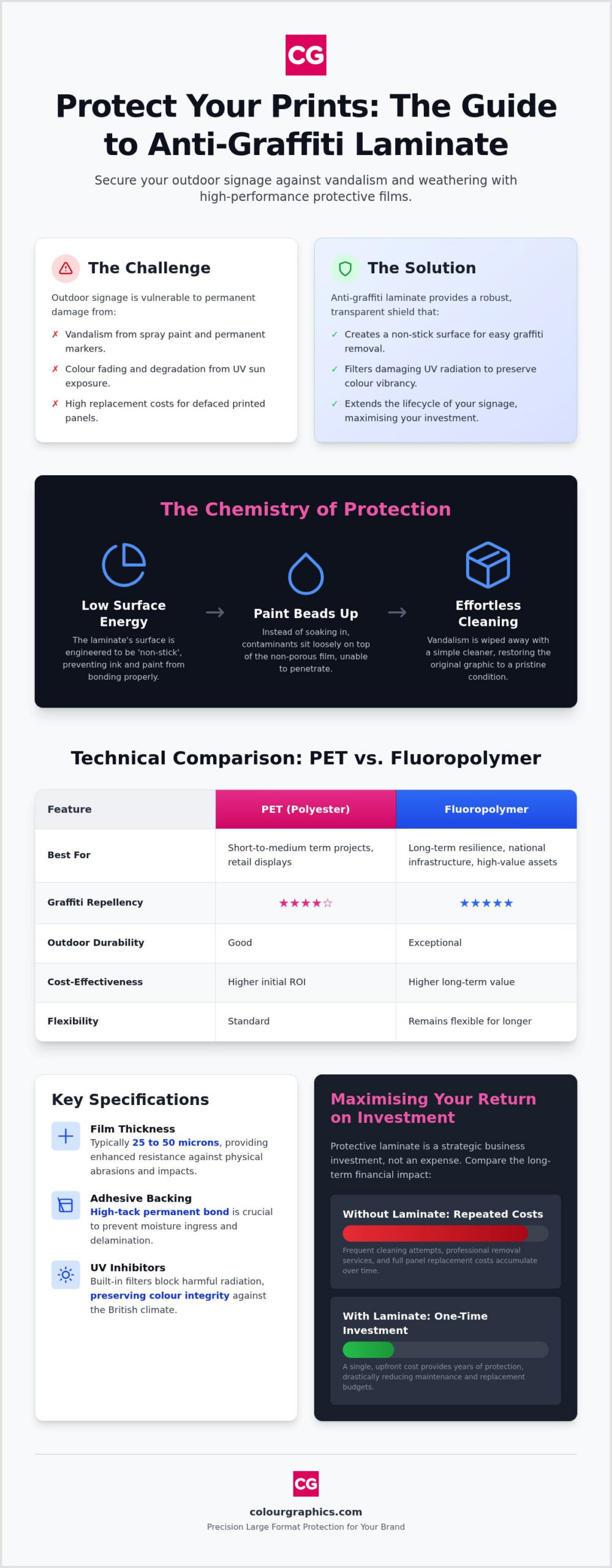
The effectiveness of these laminates lies in their incredibly low surface energy. This technical property creates a “non-stick” effect similar to high-end cookware. When a vandal applies spray paint or a marker, the ink cannot wet the surface properly. Instead of soaking in, the pigment beads up or sits loosely on top. The ink simply cannot grip. Because the material is entirely non-porous, there are no microscopic gaps for the ink to penetrate. This makes removal a simple process of wiping away the mess with a compatible cleaner, leaving the original print untouched.
Beyond Vandalism: The Secondary Benefit of UV Resistance
While the name focuses on crime prevention, these films serve as a powerful shield against solar degradation. The British sun can be surprisingly harsh on large format prints, causing rapid fading and pigment breakdown over time. High-performance anti-graffiti laminate for printed panels includes built-in UV inhibitors that filter out damaging radiation. This preserves the aesthetic lifespan of your outdoor advertising boards, preventing the washed-out look that can make a business appear neglected. You get double the value: a surface that stays clean and colours that stay bold throughout the year.
Technical Specifications: Material Performance and Durability
Selecting the right anti-graffiti laminate for printed panels requires a deep understanding of material science. It’s not just about adding a clear layer; it’s about the specific polymer structure that dictates how the panel reacts to solvents, impact, and sunlight. High-performance films are typically categorised into two main types: PET and Fluoropolymer. Each offers distinct advantages depending on the environment and the required lifespan of your signage.
PET vs. Fluoropolymer: Choosing the Right Film
PET (Polyester) films are the workhorse of the industry. They offer excellent clarity and are highly resistant to the chemicals found in most graffiti removal agents. They’re an ideal, cost-effective choice for retail displays and short-to-medium term projects. However, for national infrastructure or high-value assets, Fluoropolymer laminates are the superior choice. These films possess even lower surface energy, meaning they repel contaminants more effectively and remain flexible over a longer period. While PET is tough, Fluoropolymer is the “fit and forget” solution for long-term outdoor resilience.
The finish you choose also impacts performance. Gloss finishes are traditionally more effective for anti-graffiti purposes because their ultra-smooth surface provides fewer anchor points for paint to grip. Matt finishes are available for a sophisticated, non-reflective look, but they require more advanced chemical formulations to ensure they don’t trap ghosting images after a cleaning cycle. We prioritise precision in every application, ensuring the long-term success of your Dibond printing projects.
When choosing an anti-graffiti laminate for printed panels, thickness typically ranges from 25 to 50 microns. A thicker film provides better impact resistance against physical abrasions and stone chips. Equally important is the adhesive backing. A high-tack, permanent bond is essential to prevent moisture from seeping under the edges, which is the primary cause of delamination in the field.
Weathering the British Climate
Our climate presents unique challenges that test the limits of printed media. Rapid temperature fluctuations can cause substrates and laminates to expand and contract at different rates. A high-quality laminate must be dimensionally stable to prevent cracking or peeling. By sealing the print surface entirely, these laminates block moisture ingress, which prevents the silvering effect often seen in inferior products. This technical resilience ensures your graphics remain sharp and transparent for years, regardless of heavy rain or frost.
Compatible Substrates: Protecting Your Rigid Media
The success of any protective coating depends heavily on the surface it’s bonded to. While the laminate provides the chemical resistance, the substrate provides the structural foundation. If the base material warps or expands excessively, it can stress the adhesive layer, leading to delamination or edge lifting. Selecting a substrate with high dimensional stability ensures that your anti-graffiti laminate for printed panels performs exactly as intended, even in high-traffic urban environments where physical contact is frequent.
Aluminium Composite (Dibond) and Protection
For national signage campaigns and urban wayfinding, Dibond printing remains the gold standard. This material consists of a polyethylene core sandwiched between two thin sheets of aluminium, providing incredible rigidity without the weight of solid metal. This stiffness is vital for high-tension laminates; it prevents the “bowing” effect that can occur with more flexible materials.
In public transport hubs or city centres, Dibond panels equipped with anti-graffiti shields offer a virtually indestructible solution. To achieve the ultimate durability, we recommend edge-sealing the panels. This technical step prevents moisture or cleaning solvents from penetrating the core, ensuring the laminate stays perfectly bonded to the aluminium skin for its entire service life. It’s the precision choice for long-term infrastructure projects.
PVC Boards (Foamex) and Protective Overlays
Standard Foamex board printing is often chosen for its lightweight versatility and cost-effectiveness. However, in its raw state, the compressed PVC surface is relatively soft and susceptible to deep scratches or ink penetration. By applying a high-performance anti-graffiti laminate for printed panels, you transform a budget-friendly material into a robust outdoor solution. This is particularly effective for:
- Construction site hoarding: Protecting safety information and brand logos from site dust and vandalism.
- Retail park signage: Ensuring semi-permanent displays remain pristine during seasonal promotions.
- Security fencing panels: Maintaining clear visibility of warning signs in industrial areas.
When assessing your return on investment, consider that a laminated Foamex panel often outlasts an unprotected Dibond panel in vandal-prone areas. The key to success with larger Foamex sheets is ensuring a dust-free application environment to prevent bubbles, as the PVC surface can hold a static charge. This meticulous approach to manufacturing provides the reliability you need for high-impact graphics that must stand the test of time.
Maintenance and Cleaning: Restoring Your Graphics
The need for durable, easy-to-maintain surfaces is also critical in specialised healthcare environments. Experts such as Find Memory Care highlight how high-quality materials and thoughtful design are essential for creating safe and supportive spaces in care settings.
The true value of anti-graffiti laminate for printed panels becomes apparent the moment your signage is targeted. While the coating prevents permanent bonding, the restoration process still requires a methodical approach to ensure the surface remains pristine. You don’t need a heavy industrial team to manage this; you just need the right toolkit and a professional protocol. Maintaining the easy-clean properties of your high-performance panels is a straightforward task when you understand the chemistry of the barrier.
The Cleaning Protocol: A Professional Guide
Before applying any solvents, always test your chosen cleaning agent on a small, inconspicuous area. This ensures that the chemical won’t react unexpectedly with the specific laminate grade. For most tagging, a mild detergent or a dedicated citrus-based cleaner is sufficient. If you’re dealing with stubborn spray paint, specialist solvents like Isopropyl Alcohol (IPA) or proprietary graffiti removers can be used effectively on these non-porous surfaces.
The technique is as important as the chemical. Use a soft microfibre cloth and work from the outside of the graffiti inwards. This prevents spreading the ink further across the clean areas of the panel. Avoid abrasive scrubbers or steel wool; these will create microscopic scratches that trap future dirt and ruin the gloss finish. Once the pigment is lifted, rinse the area thoroughly with clean water to remove any chemical residue. Drying the surface with a lint-free cloth prevents water spots and keeps the graphic looking sharp.
Long-Term Care and Inspection
Signs located in high-risk urban areas should be inspected at least once a month. Catching vandalism early is always better, as some pigments can become harder to shift if left in direct sunlight for months. Look for signs of laminate fatigue, such as clouding or “silvering” at the edges. This often indicates that the bond is failing or that overly aggressive chemicals have been used in previous cleaning cycles. You want to identify these issues before moisture ingress compromises the print.
If a panel has been cleaned multiple times and shows significant physical scratching or dulling, it may be time to consider a replacement. However, with the right anti-graffiti laminate for printed panels and a gentle cleaning regime, your signage should remain functional and vibrant for its intended service life. If you’re ready to secure your next project with high-performance protection, order your custom printed panels today.
Maximising ROI: Why Anti-Graffiti Laminate is a Business Necessity
Signage isn’t just a marketing expense; it’s a capital asset. For facilities managers and business owners, the financial logic of adding an anti-graffiti laminate for printed panels is undeniable. When you compare the marginal cost of a high-performance coating against the full price of re-printing and shipping a defaced Dibond panel, the protective layer pays for itself after a single incident. It transforms a vulnerable surface into a resilient, long-term investment that secures your initial budget.
Beyond the direct replacement costs, consider the efficiency of your maintenance budget. Traditional cleaning of unprotected boards often leads to “ghosting” or surface damage, eventually requiring a total replacement anyway. By specifying a specialist laminate during the manufacturing phase, you significantly reduce the labour hours required for site upkeep. A quick wipe-down replaces a complex restoration project, allowing your team to focus on higher-value tasks whilst your estate remains in peak condition throughout the year.
Protecting Brand Reputation
We’ve been at the forefront of UK-based manufacturing since 1980, specialising in high-impact large format solutions that stand the test of time. Our commitment to precision means we don’t just print; we engineer signage for the realities of the British climate and the rigours of urban life. We provide the expert-level discourse required for complex technical specifications, ensuring every anti-graffiti laminate for printed panels we produce meets the highest industry standards for durability and clarity.
With our national delivery capabilities, we support large-scale projects across the United Kingdom, providing the reliability and speed that modern businesses demand. We act as your high-capacity partner, handling meticulous requirements with ease so you can enjoy the peace of mind that comes from superior craftsmanship. Precision is our standard, and your brand’s integrity remains our absolute priority.
Secure the Future of Your High-Impact Signage
Protecting your large format assets requires more than just a standard finish; it demands a strategic barrier engineered for resilience. By choosing the right anti-graffiti laminate for printed panels, you’re not just preventing vandalism; you’re extending the aesthetic life of your brand and drastically reducing long-term maintenance costs. We’ve explored how technical specifications like low surface energy and UV resistance work together to ensure your Dibond and Foamex displays remain pristine, regardless of the urban environment. It’s a calculated investment that preserves the precision of your original graphics whilst securing your professional reputation.
As a family-owned British business since 1980, Colour Graphics brings decades of manufacturing excellence to every project. We’re expert large format manufacturers dedicated to reliability, offering national UK delivery on all rigid media to ensure your campaign arrives protected and ready for immediate impact. It’s time to stop worrying about the potential for damage and start investing in high-performance results that last. Take the first step toward total brand security and project longevity today.
Enquire about protected printed panels at Colour Graphics and let our specialists help you specify the perfect solution for your next national campaign.
Frequently Asked Questions
Does anti-graffiti laminate make the printed panels look different?
Anti-graffiti laminate for printed panels typically enhances the visual impact rather than altering the core design. High-performance PET or Fluoropolymer films are engineered for maximum transparency, ensuring your graphics remain sharp and vibrant. While a gloss finish can make colours appear more saturated and deep, a matt option provides a sophisticated, non-reflective surface. Both choices provide a professional, high-end feel that signals quality and durability to anyone viewing your signage.
Can I use any cleaning solvent on an anti-graffiti laminated surface?
You shouldn’t use just any solvent, as aggressive industrial chemicals can eventually degrade the protective layer. We recommend starting with mild detergents or citrus-based cleaners for light tagging. For tougher spray paint, Isopropyl Alcohol (IPA) is highly effective and safe for most professional-grade laminates. Always avoid abrasive scouring pads or steel wool; these create microscopic scratches that trap dirt and permanently dull the finish of your printed panels.
How long does the anti-graffiti protection actually last?
The lifespan of the protection depends on the specific film chemistry and the intensity of local environmental exposure. Standard PET-based films generally provide reliable protection for three to five years in the British climate. Premium Fluoropolymer options can extend this lifecycle to a decade or more. Regular inspections and gentle cleaning protocols help maintain the laminate’s integrity, ensuring your investment continues to repel vandals and resist UV fading for its intended service life.
Is it possible to apply anti-graffiti laminate to existing signs?
While it’s technically possible to apply film to existing signage, we strongly advise against it for professional results. Achieving a perfect, bubble-free bond requires a controlled manufacturing environment free from dust and static. Applying laminate in the field often leads to trapped debris and poor edge adhesion, which eventually causes peeling. For maximum durability and precision, the protective layer should be integrated during the initial production of your Dibond or Foamex panels.
What is the difference between anti-graffiti paint and anti-graffiti laminate?
Anti-graffiti paint is typically a sacrificial or permanent liquid coating used on porous surfaces like brick or concrete. In contrast, anti-graffiti laminate is a high-performance, non-porous film specifically engineered for printed media. Laminates provide a much smoother, ultra-clear finish that preserves the exact detail of your graphics. They also offer superior UV protection compared to most paints, making them the definitive choice for maintaining brand integrity on large format displays.
Which printed panels are best suited for anti-graffiti protection?
Rigid substrates like Dibond and Foamex are the most compatible choices for this technology. Dibond’s extreme dimensional stability makes it the gold standard for high-tension laminates in public transport hubs. Foamex is an excellent, lightweight alternative for semi-permanent outdoor use when paired with a protective overlay. Using an anti-graffiti laminate for printed panels on these materials ensures a flat, secure bond that withstands both physical impact and chemical cleaning cycles.
Does the laminate protect against scratches as well as paint?
Yes, the laminate acts as a robust physical shield that significantly improves the scratch resistance of your signage. While no film is entirely indestructible, the thickness of the protective layer absorbs scuffs and minor abrasions that would otherwise ruin the raw print. This is especially valuable in high-traffic areas where pedestrians or equipment might accidentally brush against the panels. It keeps your graphics looking pristine even in the toughest urban conditions.
Is anti-graffiti laminate environmentally friendly or recyclable?
Environmental considerations depend on the material choice, with PET-based laminates being more widely recyclable than complex Fluoropolymer films. However, the primary environmental benefit comes from product longevity. By protecting your signage from vandalism and UV damage, you avoid the waste associated with frequent replacements. This approach reduces the overall consumption of raw materials and energy over the lifecycle of your project, aligning with modern sustainability goals for national signage campaigns.