Windproof Banner Solutions: The Professional Guide to High-Wind Displays 2026
A banner that transforms into a sail isn’t a marketing tool; it’s a structural liability. Selecting effective windproof banner solutions requires a move beyond standard PVC and an embrace of technical substrates specifically engineered for airflow. You need a display that works with the environment rather than against it to ensure your brand remains visible when the British weather turns.
It’s incredibly frustrating to watch a standard display tear from its fixings or fade into illegibility within weeks of installation. You’ve likely experienced the stress of wondering if your signage will survive a typical storm or if it will end up as a shredded mess that damages your structure. We believe your outdoor branding should be as resilient as the professional reputation it represents.
This guide provides the technical insight to specify and secure outdoor displays whilst maintaining high-impact visibility and safety. You’ll learn how to balance material permeability with reinforced finishing and discover why the right substrate makes all the difference for long-term campaigns. We’ll explore the science of airflow and the specific finishing techniques that ensure your investment lasts the entire season.
Key Takeaways
- Identify the “sail effect” and how it converts wind into destructive kinetic energy against standard solid PVC surfaces.
- Specify mesh banners as the primary choice for windproof banner solutions, leveraging a perforated structure that allows for significant air passage.
- Explore how rotational hardware in promotional flags allows displays to move with the wind, reducing stress on the fabric and fixings.
- Implement essential finishing techniques like heat-welded hems and precise eyelet spacing to distribute loads evenly across the display.
- Partner with high-capacity specialists to ensure your branding remains legible and secure throughout a full outdoor campaign.
Understanding Wind Loading: Why Standard Banners Fail Outdoors
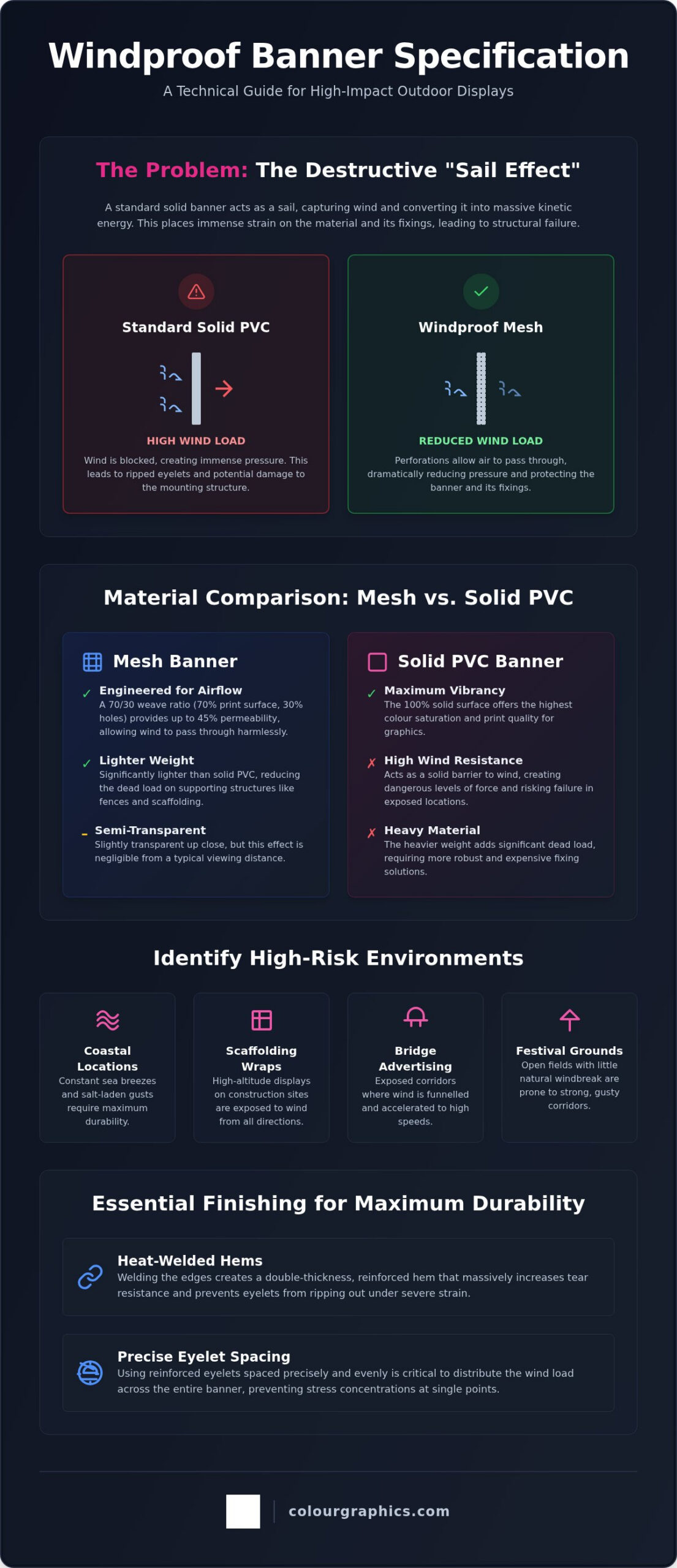
A standard PVC banner is essentially a wall of resistance. When gusty conditions hit a solid surface, the material acts as a sail, capturing air and converting it into massive kinetic energy. This phenomenon, known as “The Sail Effect,” places immense strain on the material itself and the structure it’s attached to. Without the right technical specifications, your outdoor display becomes a liability rather than an asset.
Wind loading refers to the specific pressure exerted on the Banner and its supporting framework. According to technical standards like ASCE 7-22, wind pressure calculations are vital for ensuring structural integrity. In high-wind scenarios, a solid 510gsm PVC banner can exert hundreds of kilograms of force on a fence or scaffolding rig. This pressure often leads to the most common failure point: eyelets ripping through unreinforced hems. Investing in standard vinyl for exposed locations is a false economy; the cost of replacement and potential structural damage far outweighs the initial saving. This reality necessitates the move toward professional windproof banner solutions that prioritise permeability and structural reinforcement.
The Physics of Airflow in Large Format Print
Surface area directly correlates to wind resistance. A large, solid banner creates a high-pressure zone on the windward side and a low-pressure vacuum on the leeward side, resulting in a physical “pulling” force. In the UK, where gusty corridors are common, this force can buckle metal fences or destabilise scaffolding. High-capacity displays must account for this by incorporating materials that allow air to pass through the substrate, significantly reducing the load on the fixings.
Identifying High-Risk Environments
Certain locations demand a more rigorous approach to signage specification. You must assess the environment before selecting your materials to ensure the longevity of your campaign. High-risk areas include:
- Coastal Locations: Exposure to constant sea breezes and salt-laden gusts.
- Scaffolding Wraps: High-altitude displays on construction sites that catch wind from all directions.
- Bridge-Mounted Advertising: Exposed corridors where wind speed is naturally funnelled and accelerated.
- Festival Grounds: Open fields amongst gusty corridors where there is little natural windbreak.
By understanding these risks, you can make informed decisions that protect your brand and your budget. Selecting a partner who understands the nuances of high-wind displays is the first step toward a secure and impactful outdoor presence.
Mesh Banners: The Industry Standard for Windproof Advertising
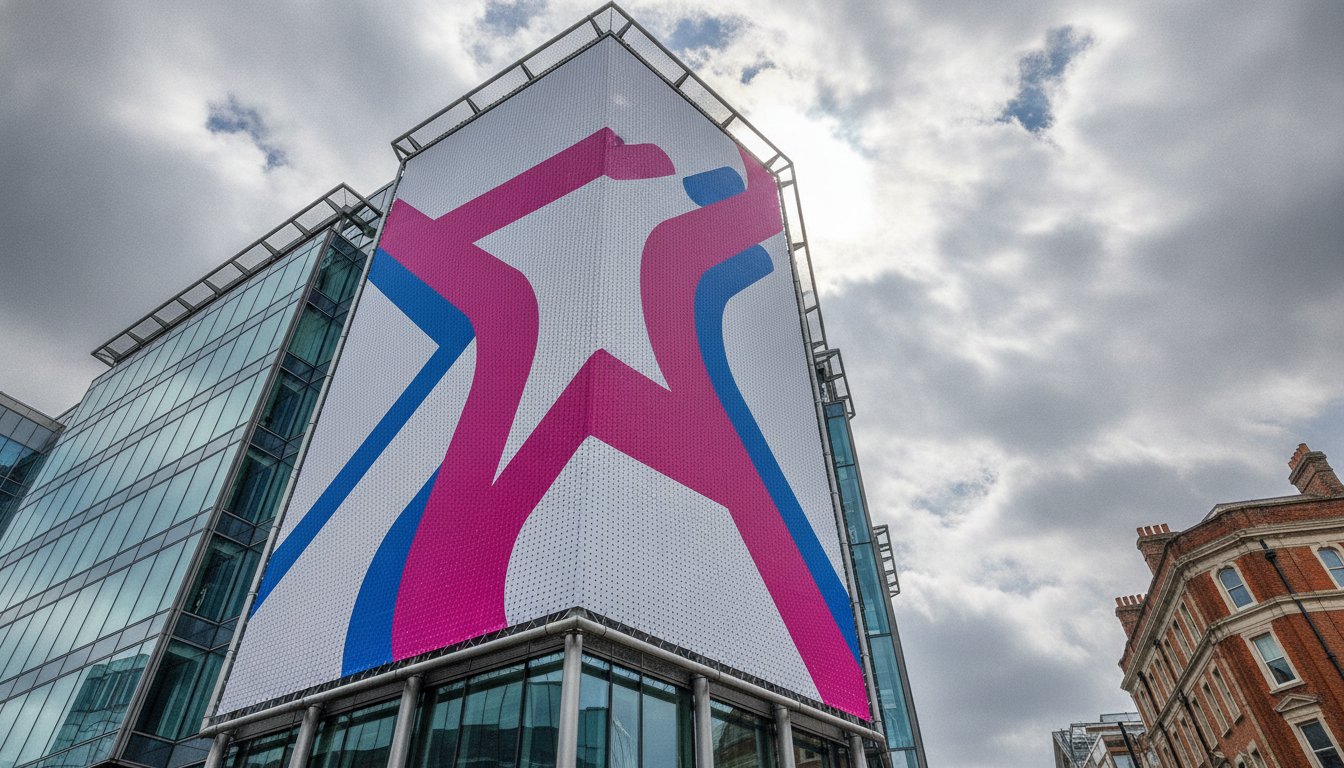
Mesh is the engineering answer to the “sail effect” that plagues standard outdoor displays. By utilising a perforated weave, mesh acts as the foundation for modern windproof banner solutions. This substrate doesn’t just resist the wind; it invites it to pass through. Thousands of micro-perforations across the surface area break up air pressure, allowing the display to remain stable whilst your branding stays perfectly visible. It’s the difference between a structure that stands firm and one that buckles under the first sign of a British gale.
Most professional mesh substrates operate on a 70/30 weave ratio. This means 70% of the surface area is dedicated to your printed graphics, while 30% consists of tiny holes for airflow. In technical terms, this provides between 35% and 45% permeability. For high-capacity campaigns, this reduction in wind load is transformative. It allows for massive building wraps and site hoardings that would otherwise be physically impossible to secure safely. If you’re looking to deploy large-scale branding on construction sites or temporary fencing, choosing a specialist for your Mesh Banners ensures your project meets these technical requirements without sacrificing impact.
Mesh vs PVC Banners: A Specification Comparison
Weight is a critical factor in any outdoor installation. Mesh is significantly lighter than its solid PVC counterparts, which reduces the dead load on your fixings and supporting structures. While solid vinyl offers 100% opacity and maximum colour vibrancy, mesh is semi-transparent. This transparency is negligible from a distance but becomes apparent during close-up viewing. Our guide on Mesh vs PVC Banners: Which Material Suits Your Project? explores these trade-offs in detail, helping you balance visual density with structural safety.
Choosing the Right Mesh Density
Precision in material selection prevents failure. Not all mesh is created equal, and the density you choose should reflect the specific wind risks of your site:
- Standard Mesh: The versatile choice for site hoarding and perimeter fencing where moderate airflow is required.
- Fine Mesh: Features smaller holes and a tighter weave. It’s ideal for high-resolution graphics where the viewing distance is shorter, though it offers slightly less wind resistance.
- Coarse Mesh: Designed for extreme environments like scaffolding towers and exposed bridges. The wider weave maximises air passage to protect the underlying structure.
When designing for mesh, clarity is key. Use bold typography and high-contrast colour palettes to compensate for the perforated surface. This approach ensures your message remains legible even when the sun shines through the material from behind.
Dynamic Alternatives: Promotional Flags and Fabric Solutions
Static mesh isn’t always the right fit for every campaign. For events where wind direction shifts constantly, dynamic windproof banner solutions like promotional flags offer a superior alternative. These displays don’t fight the wind; they dissipate its energy through controlled movement. By allowing the substrate to rotate and flow, you eliminate the rigid resistance that causes standard displays to fail. It’s a proactive approach to durability that ensures your brand remains visible regardless of sudden gusts.
The secret to this resilience lies in the rotational hardware. High-quality flag systems utilise ball-bearing spindles that allow the graphic to pivot 360 degrees. This ensures the flag always faces the path of least resistance, preventing the tangling and tearing common in cheaper, static alternatives. We prioritise these precision-engineered components because they provide the reliability you need for high-impact outdoor branding. It’s about more than just the fabric; it’s about a hardware system that works in harmony with the elements.
Feather and Teardrop Flags for High-Wind Areas
Aerodynamics play a vital role in flag design. Teardrop and feather shapes are specifically engineered to minimise drag. By tapering the surface area where wind speed is highest, these designs maintain structural integrity whilst keeping your message clear. We utilise flexible glass-fibre poles to maintain constant tension, allowing the system to bend without snapping under pressure. Choosing the right base is equally critical for safety. Ground spikes provide maximum stability for soft turf, whilst heavy-duty water bases offer the necessary ballast for concrete or tarmac surfaces where drilling isn’t an option.
Fabric Displays and Air Permeability
For premium events where aesthetics are as important as durability, Fabric Banners offer a sophisticated solution. Modern polyester knit fabrics are naturally breathable, allowing air to move through the fibres much like a high-performance sports garment. This permeability reduces the “crinkling” noise and glare associated with traditional vinyl, providing a high-end finish that remains steady in the breeze.
Integrating these fabrics into outdoor-rated frames using silicone edge graphics (SEG) creates a drum-tight display. This tension prevents the fabric from flapping, which significantly extends the life of the print and maintains a polished professional appearance. It’s a meticulously engineered system that provides peace of mind for national campaigns where visual excellence and structural safety must go hand in hand. You get the vibrancy of a high-resolution print with the technical performance of a wind-resistant substrate.
Specifying for Durability: Essential Finishing and Fixing
Material choice is only half the battle. Even the most advanced windproof banner solutions will fail if the perimeter isn’t engineered to handle high-velocity gusts. Professional finishing transforms a simple print into a structural component capable of withstanding the British elements. Without these technical reinforcements, the kinetic energy captured by the substrate has nowhere to go except through your fixings, often with catastrophic results.
Reinforced hems are non-negotiable for any outdoor installation. We utilise double-stitched or heat-welded edges to ensure the perimeter can withstand constant tension. Heat-welding is particularly effective as it fuses the layers of material together, creating a bond that is frequently stronger than the substrate itself. This prevents the eyelets from pulling through the material when the wind loading peaks. If you’re looking for a partner to manufacture these high-spec displays, you can order professionally finished banners that meet these exact standards.
Eyelet frequency is a critical calculation for even load distribution. Placing eyelets too far apart creates concentrated stress points that lead to material fatigue. For high-exposure sites, we suggest placing high-quality nickel or brass eyelets every 50cm. This ensures that the pressure is shared across the entire structure rather than straining a single corner. When installing in public-facing areas or overhead, this redundancy is a fundamental safety requirement to prevent the display from becoming a hazard.
Finishing Techniques for Extreme Longevity
For the most demanding environments, webbing reinforcement adds seatbelt-grade strength to the banner perimeters. This involves sewing a high-tensile polyester tape into the hem, providing an internal skeleton that is virtually impossible to tear. You must also consider whether pole pockets or eyelets suit your frame better. Pole pockets distribute tension across the entire width of the banner, which often provides a flatter, more stable surface in gusty corridors. For more advice on maintaining these technical displays, read our guide on Ensuring Longevity: How to Care for Your Outdoor Banners.
Secure Fixing Hardware Checklist
The hardware you choose is the final link in your wind-resistance strategy. Rigid fixings like standard cable ties often snap under the sudden “snap” of a gust. Instead, we recommend elasticated bungee cords or toggles. These provide essential “give,” acting as shock absorbers that dissipate energy before it reaches the material. Your maintenance checklist should include:
- Elasticated Bungees: To absorb sudden kinetic energy and prevent material fatigue.
- Heavy-Duty Toggles: For secure anchoring to scaffolding or fences.
- Regular Inspections: Checking for abrasion where the material meets metal edges.
Precision matters. A single weak point in your finishing or fixing can compromise an entire national campaign. By specifying these technical details at the start, you ensure your branding remains secure and legible throughout the season.
Expert High-Wind Printing: Professional Solutions from Colour Graphics
Precision manufacturing is the final safeguard against display failure. At Colour Graphics, we combine technical expertise with high-capacity production to deliver windproof banner solutions that thrive in the most demanding British environments. We don’t just print on mesh; we engineer a complete visual solution that balances aesthetic impact with structural reliability. Our commitment to precision ensures that your high-resolution graphics remain sharp and legible, even when printed on perforated substrates designed for maximum airflow.
We act as your collaborative partner, helping you specify the exact materials required for your site’s unique wind load profile. By utilising premium substrates specifically selected for the UK climate, we provide the peace of mind that your investment will withstand a full season of gusty conditions. Our role is to ensure your brand remains visible and secure, allowing you to focus on the broader objectives of your national campaign. We prioritise reliability and craftsmanship so that you can deploy your branding with absolute confidence.
Precision Manufacturing in the UK
Our UK-based facility utilises state-of-the-art large format technology to produce vibrant, UV-stable results. This ensures that your brand colours remain true even after prolonged exposure to the elements. Quality control is rigorous; we inspect every heat-welded hem and nickel eyelet to guarantee they meet our exacting standards for high-tensile strength. For organisations prioritising environmental consciousness, we also offer sustainable, PVC-free mesh options that provide the same wind-resistant performance without compromising your eco-friendly objectives.
Streamlined Ordering for National Professionals
Managing a national rollout requires logistical clarity and speed. We have designed our ordering process to be as efficient as possible for bulk requirements and time-critical projects. You can easily specify your finishing requirements and upload your artwork through our streamlined system, confident in our ability to handle complex, high-volume orders with ease. With reliable delivery across the United Kingdom, we ensure your displays arrive ready for immediate deployment, regardless of the scale of your project.
Explore our range of windproof mesh banners today and secure your outdoor branding against the elements with professional-grade materials.
Secure Your Branding Against the British Elements
Deploying effective windproof banner solutions requires a strategic shift from standard resistance to engineered permeability. By selecting high-airflow mesh or dynamic promotional flags, you ensure your message remains legible whilst protecting the underlying structure from kinetic damage. Success in high-wind environments isn’t just about the substrate; it’s about the technical precision of heat-welded hems and shock-absorbing fixings that distribute the load evenly across the display.
We understand that your professional reputation relies on the reliability of your displays. As a family-owned business with expertise dating back to 1980, Colour Graphics specialises in high-performance large format digital print designed for the realities of the UK climate. We prioritise meticulous craftsmanship and offer fast UK-wide delivery on all custom orders to keep your national campaigns moving at pace. Our team is ready to help you specify the perfect materials for your specific site requirements.
Order Your Professional Windproof Banners from Colour Graphics today to ensure your brand stands firm regardless of the weather. We look forward to partnering with you on your next high-impact project.
Frequently Asked Questions
What is the best banner material for high winds?
Mesh banners are the industry standard for high-wind environments due to their perforated structure. These displays feature thousands of micro-perforations, typically offering 35% to 45% airflow permeability. This technical design allows wind to pass through the substrate rather than pushing against it, significantly reducing the sail effect. For exposed sites like open fields or coastal areas, mesh provides the structural reliability needed to protect both the print and the supporting frame.
Do mesh banners look blurry because of the holes?
Mesh banners maintain excellent graphic clarity despite their perforated surface. Whilst the micro-holes are visible from a few centimetres away, they become virtually invisible at a standard viewing distance of two metres or more. To maximise impact, we recommend using bold typography and high-contrast colours. This ensures your branding remains vibrant and legible, even when the substrate is allowing air to pass through the material for technical performance.
Can I use a standard PVC banner on a scaffold tower?
Using a standard PVC banner on a scaffold tower is highly discouraged because solid vinyl captures wind energy like a sail. This creates immense kinetic force that can destabilise the tower or cause the eyelets to rip through the material. Professional windproof banner solutions like mesh are essential for high-altitude installations. They ensure the safety of the public and the integrity of the scaffolding by minimising structural load during gusty conditions.
How long will a windproof mesh banner last outdoors?
A professionally manufactured mesh banner typically lasts between one and two years in standard outdoor conditions. This longevity depends on the intensity of local weather and the quality of the installation. We utilise UV-stable inks and premium substrates designed for the British climate to prevent premature fading. Regular maintenance, such as checking for abrasion against metal edges, will further extend the life of your campaign across multiple seasons or years.
Are windproof banners more expensive than standard ones?
Windproof mesh banners often carry a slightly higher initial cost than standard PVC, but they represent a superior long-term investment. Standard vinyl frequently fails in exposed locations, leading to replacement costs and potential structural damage. By specifying mesh from the outset, you avoid the false economy of cheap materials. The durability and safety provided by specialist substrates ensure your budget is protected throughout the duration of your high-impact outdoor campaign.
What is the best way to secure a banner in a windy area?
The most effective method is using elasticated bungee cords combined with reinforced hems and eyelets spaced every 50cm. Bungee toggles act as shock absorbers, dissipating sudden kinetic energy before it reaches the banner material. This flexibility prevents the eyelets from tearing under pressure. You should always utilise every available eyelet to ensure the load is distributed evenly across the entire perimeter of the display for maximum structural stability.
Can mesh banners be printed on both sides?
Mesh banners are primarily designed for single-sided printing because the perforated weave is semi-transparent. If you print on both sides, the graphics from the reverse will show through, compromising the legibility of your message. For double-sided requirements in windy areas, it’s often more effective to use two mesh banners back-to-back or consider promotional flags, which utilise movement to remain visible from multiple angles whilst dissipating wind energy effectively.
Do you provide the bungee cords and fixings for installation?
We offer a comprehensive range of fixing accessories, including heavy-duty cable ties and elasticated bungee toggles, to support your installation. These can be added to your order during the specification process. Please note that whilst we manufacture and deliver high-quality windproof banner solutions across the UK, we do not provide on-site installation services. Our focus remains on precision manufacturing to ensure your hardware and substrates meet professional standards.