Best Outdoor Printed Sign Materials UK: 2026 Guide
A sign that looks magnificent in July but brittle and faded by January isn’t just a maintenance headache; it’s a direct hit to your brand’s perceived quality. You’ve likely seen it happen: banners flapping uselessly in the wind or rigid boards bowing under the weight of a typical British downpour. It’s frustrating to invest in marketing only to watch the elements erode your professional image. Finding the best material for outdoor printed signs UK requires looking beyond the price tag to understand how different substrates interact with our unique climate.
We’ll provide the clarity you need to choose with absolute confidence. Precision matters. This guide explores the most durable, cost-effective, and high-impact materials available for 2026, ensuring your brand survives the harshest elements. You’ll discover the specific lifespans of rigid media like Dibond and Foamex, alongside the technical advantages of mesh for high-wind locations. We’re stripping away the guesswork to help you secure signage that remains vibrant, structurally sound, and professional for years to come.
Key Takeaways
- Identify why simple waterproofing is insufficient and how to protect your brand against UK specific environmental threats like UV radiation and high winds.
- Compare the structural integrity of rigid substrates to find the right balance between the permanent durability of Dibond and the semi-permanent versatility of Foamex.
- Understand the technical advantages of mesh banners for high-exposure sites where standard PVC might fail due to wind resistance.
- Master a clear two-step selection framework to determine the best material for outdoor printed signs UK based on your specific mounting surface and intended lifespan.
- Gain insights into how precision large format printing and UK-based manufacturing provide the quality control necessary for high-performance results.
Understanding the Challenges of Outdoor Signage in the UK Climate
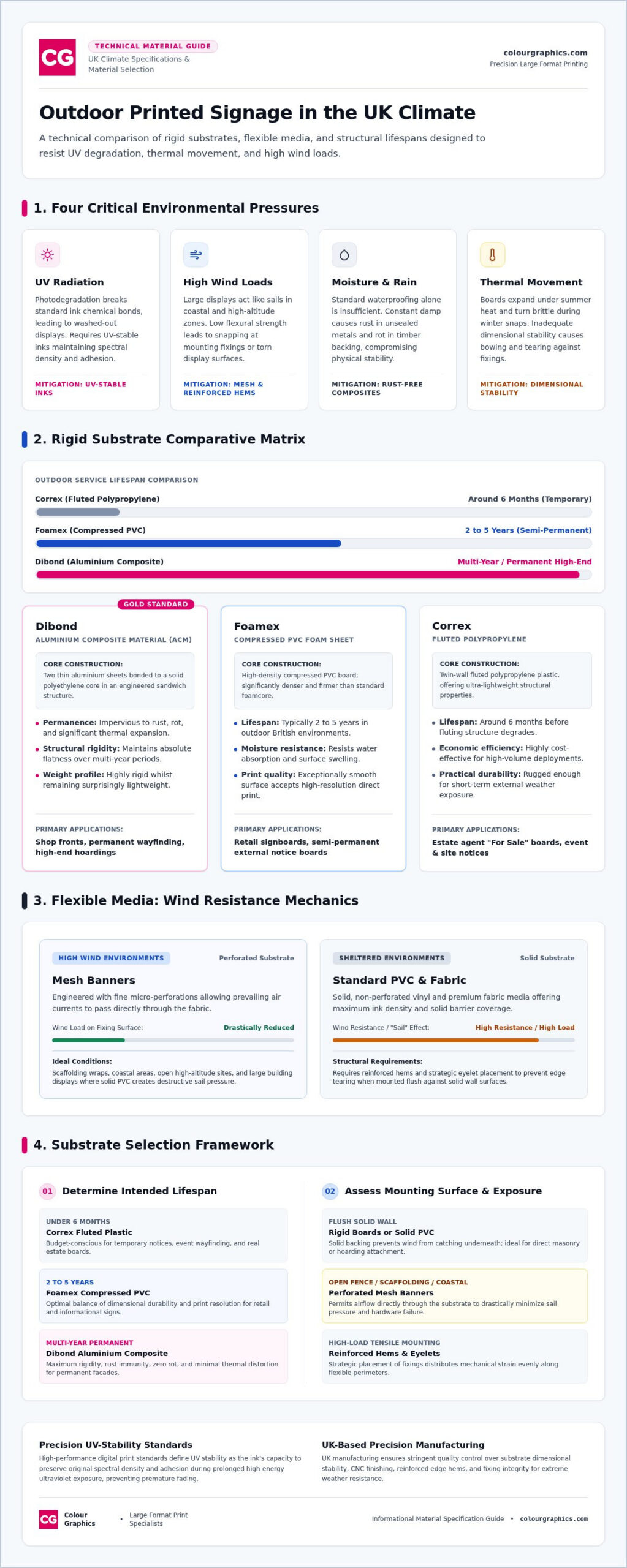
The UK climate is notoriously unpredictable. It’s a testing ground for any outdoor signage, where a single season can degrade a poorly specified display. While many providers claim their products are waterproof, moisture is often the least of your worries. True durability involves a complex interplay between the substrate’s chemical composition and the print technology used to brand it. Selecting the best material for outdoor printed signs UK means accounting for four relentless environmental pressures: UV radiation, high winds, moisture, and temperature fluctuations.
Rigid materials behave differently as the mercury rises and falls. In the heat of summer, a PVC-based board might expand, whilst a cold winter snap can make it brittle. Without considering this thermal movement, signs can warp or pull against their fixings. Precision manufacturing ensures that the chosen substrate has the necessary dimensional stability to handle these shifts without compromising the visual impact. It’s why we look beyond the surface to ensure the core of the material is fit for its specific environment.
UV Resistance and Colour Longevity
Sunlight is the silent killer of vibrant marketing. Standard pigments often succumb to photodegradation, where UV light breaks the chemical bonds of the ink. This results in the “washed-out” look that plagues budget displays. For long-term branding, UV-stable inks are a non-negotiable requirement. In the context of 2026 digital print standards, UV-stability is defined as the ink’s capacity to maintain its original spectral density and adhesion throughout prolonged exposure to high-energy ultraviolet radiation. It’s the difference between a sign that lasts six months and one that remains crisp for years.
Wind Load and Structural Integrity
High winds turn large-format displays into massive sails. In coastal regions or high-altitude sites, the physical pressure exerted on a sign can be immense. If the material lacks flexural strength, it will snap or tear at the mounting points. This is why we prioritise finishing techniques like reinforced hems and strategic eyelet placement. Finding the best material for outdoor printed signs UK often leads us to perforated options for exposed areas. Choosing a substrate that allows air to pass through, such as mesh, drastically reduces the load on the fixing surface and prevents structural failure.
Rigid Substrates: Comparing Dibond, Foamex, and Correx
Selecting the best material for outdoor printed signs UK often starts with a choice between three core rigid substrates. Each offers a distinct profile of durability, weight, and cost, allowing you to align your investment with the specific demands of your site. Whether you need a permanent facade for a flagship store or temporary directional boards for a weekend event, understanding the physical properties of these boards is essential for professional results. Precision in material selection prevents the common pitfalls of warping, snapping, or premature fading that can undermine your brand’s authority.
Dibond Printing: The Ultimate Permanent Solution
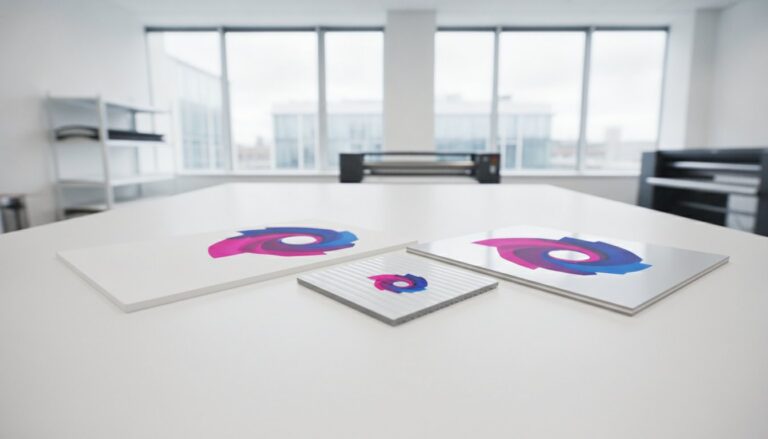
Dibond is widely regarded as the gold standard for long-term outdoor applications. It’s an aluminium composite material featuring two thin sheets of aluminium bonded to a solid polyethylene core. This sandwich construction makes it exceptionally rigid whilst remaining surprisingly lightweight. Unlike traditional timber or standard plastics, Dibond is impervious to rust, rot, and significant thermal expansion. It’s the ideal choice for shop fronts, permanent wayfinding, and high-end construction hoardings where a premium finish is mandatory. If you require a substrate that maintains its flatness and colour over several years, investing in professional dibond printing ensures your brand remains unblemished by the weather.
Foamex and Correx: When to Use Plastic-Based Boards
For projects with a shorter lifespan, plastic-based boards offer a versatile alternative. Foamex, a compressed PVC board, serves as an excellent middle ground. It’s denser and more durable than standard foam boards, typically lasting between 2 and 5 years in outdoor environments. It’s a favourite for retail displays and information boards because it accepts high-resolution print beautifully whilst resisting moisture. In contrast, Correx is the go-to for temporary needs. This fluted polypropylene is incredibly light and cost-effective, designed for short-term use such as estate agent “For Sale” signs or temporary site notices. Whilst Correx is rugged enough for outdoor use, its lifespan is generally limited to around 6 months before the fluted structure begins to show wear.
Managing large-scale rollouts requires a keen eye on weight-to-strength ratios. Rigid boards that are too heavy increase shipping costs and complicate installation, whilst those that are too flimsy fail under wind load. Our precision manufacturing process allows us to balance these factors, providing high-impact Foamex Printing and other rigid media that is easy to handle and nationally delivered. By matching the substrate to the intended duration, you ensure your marketing budget is utilised with maximum efficiency and your signage remains vibrant for its entire lifecycle.
Flexible Materials: PVC, Mesh, and Premium Fabric Banners
Whilst rigid boards provide a structural presence, flexible materials offer the scale and portability required for high-impact outdoor marketing. Standard PVC Banners remain a staple for many UK businesses due to their vibrant colour reproduction and accessible price point. They’re built to withstand the rain, yet their solid surface can cause issues in exposed areas. For these challenging environments, Mesh Banners provide an engineered solution. By using a perforated weave, mesh allows air to flow through the sign, significantly reducing the pressure on scaffolding or fences during high winds. It’s a technical choice that prioritises safety without sacrificing visual reach.
To ensure these flexible displays survive the British elements, the precision of the finishing is just as important as the substrate itself. Reinforced hems provide the necessary structural strength at the edges, whilst nickel-plated eyelets prevent rust from staining the graphic or weakening the mounting points. This attention to detail is what separates a professional installation from a temporary fix that fails at the first sign of a gale. When you’re identifying the best material for outdoor printed signs UK, always consider how the banner will be secured to its environment.
Mesh vs PVC: Choosing for Wind Resistance
The choice between mesh and solid PVC often comes down to the specific location of your display. If you’re mounting a sign against a solid wall, standard PVC banners offer maximum image clarity and ink density. However, when the sign is freestanding or attached to temporary fencing, the wind load becomes a critical safety factor. Mesh’s perforated weave allows air to pass through the material, which prevents the banner from acting like a sail and potentially damaging the structure it’s attached to. It’s the best material for outdoor printed signs UK when safety and structural integrity in high-exposure sites are the primary concerns.
Outdoor Fabric and SEG Displays
For high-end outdoor events and premium retail environments, fabric displays are rapidly becoming the preferred choice. The rise of Silicone Edge Graphics (SEG) has transformed how brands approach outdoor branding. By using stretch fabrics tensioned into a specialist frame, you can create perfectly flat, crease-free displays that rival the look of rigid boards. These fabric banners are particularly popular amongst eco-conscious brands because many modern textiles are recyclable and lighter to transport, reducing the overall carbon footprint of the campaign. Fabric offers a sophisticated, non-reflective finish that looks exceptional under natural light.
Selection Framework: How to Choose Your Sign Material
Choosing the best material for outdoor printed signs UK involves more than a cursory glance at a price list. It requires a clinical assessment of your specific site conditions and project goals. A sign that fails prematurely is a wasted asset; a sign that is over-specified for a short-term event is a missed budget opportunity. To ensure your investment delivers maximum ROI, follow this structured selection framework:
- Determine the intended lifespan: Categorise your project as temporary (under 6 months), semi-permanent (up to 2 years), or permanent (5 years plus).
- Assess the mounting surface: Identify if you’re fixing to a flat wall, a post, a wire fence, or a textured brick surface.
- Evaluate the local environment: Consider if the site is sheltered amongst city buildings or exposed to high-altitude winds and coastal salt air.
- Consider the viewing distance: High-resolution detail is vital for eye-level retail signs, whilst large-scale banners only require clarity from a distance.
- Factor in transport: If you’re managing a national rollout, the weight and stackability of the material will significantly impact your distribution costs.
Lifespan vs Budget: Finding the Sweet Spot
Calculating the “cost per day” is the most professional way to justify your material choice. Whilst a Correx board is cheaper initially, using it for a permanent shop front is a false economy. It’ll likely warp or fade within months, necessitating a full replacement. Investing in 3mm Dibond for long-term sites often saves money over time because it eliminates the labour and material costs of frequent updates. For semi-permanent displays, 5mm Foamex provides extra rigidity over the 3mm variant, preventing the board from bowing when mounted in areas with temperature fluctuations.
Mounting and Installation Considerations
The physical weight of your substrate dictates your installation strategy. Rigid Dibond is heavy and requires secure mechanical fixings, whereas lightweight Correx can be cable-tied to railings in seconds. If you’re applying graphics directly to a challenging surface like a concrete wall or a vehicle, High Tack Adhesive Vinyl is the superior choice. It bypasses the need for a rigid board entirely, bonding securely to the substrate to create a seamless, professional finish. For those requiring a versatile and durable solution, you can browse our full range of precision-engineered outdoor signage to find the perfect match for your specific mounting requirements.
Expert Production: Why Precision Manufacturing Matters
Selecting the best material for outdoor printed signs UK is only half the battle. The structural integrity of your signage depends entirely on how that material is processed. Precision manufacturing transforms a raw substrate into a high-performance brand asset. At Colour Graphics, we combine decades of expertise with state-of-the-art large format digital printing to ensure every sign we produce meets the rigorous demands of the British climate. It’s about more than just aesthetics; it’s about engineering a product that lasts.
Our UK-based facility allows for total oversight of the production cycle. We don’t outsource quality. By keeping manufacturing in-house, we provide faster turnaround times and a level of quality control that international shipping simply can’t match. As a family-owned business since 1980, we’ve refined our processes to support national delivery with absolute reliability. We understand that your reputation is on the line every time a sign is installed, and we take that responsibility seriously.
Advanced Ink Technology and Adhesion
Printing on non-porous surfaces like aluminium composite or PVC requires more than just standard ink. It demands a sophisticated chemical bond. Our advanced UV-curing technology ensures that pigments are locked into the surface, creating a finish that won’t flake, peel, or crack when exposed to heavy rain or temperature shifts. To maintain the integrity of your visual identity, rigorous colour calibration is performed across all devices to ensure brand consistency regardless of the substrate chosen. This technical precision ensures your colours remain vibrant and accurate for the duration of the sign’s lifespan.
The Value of Professional Finishing
A sign’s durability is often determined by its edges. Manual trimming can leave micro-fractures or uneven cuts that invite moisture ingress, which eventually leads to delamination. We utilise CNC cutting technology to provide perfectly clean, sealed edges for all our rigid boards, from Dibond to Foamex. For illuminated displays, our proprietary SEG extrusions provide the exact tension needed for a flawless, high-impact finish that remains secure amongst the elements.
Final Checklist for Professional Outdoor Signage:
- Verify UV-resistance ratings for your specific ink and substrate combination.
- Confirm the mounting requirements match the material’s weight and flexural strength.
- Ensure all flexible banners include reinforced hems and nickel-plated eyelets.
- Check that rigid boards have been CNC-routed for dimensional accuracy and clean edges.
- Specify high-tack adhesive vinyl for direct applications on challenging surfaces.
Ordering for 2026 is streamlined through our professional platform, ensuring your custom signage is manufactured with precision and delivered across the UK with speed. When you choose a partner that prioritises technical excellence, you’re not just buying a sign; you’re securing peace of mind.
Securing Your Brand’s Outdoor Presence for 2026
Securing a professional outdoor presence requires more than just a bold design; it demands a technical understanding of how materials survive the British climate. You now have the framework to distinguish between the long-term structural integrity of Dibond and the tactical advantages of mesh for high-wind environments. By prioritising UV-stable inks and precision CNC finishing, you ensure your brand remains vibrant regardless of the weather. It’s about protecting your investment whilst maintaining a high-impact visual identity that commands attention.
Choosing the best material for outdoor printed signs UK is a strategic decision that balances durability with your specific project goals. With over 40 years of UK printing expertise, we’ve refined our manufacturing to handle complex large format and SEG requirements with absolute precision. We’re ready to act as your high-capacity partner, providing high-performance results and reliable national delivery for every site across the country. We don’t just print signs; we build brand assets that endure.
Take the next step in elevating your professional image today. Explore our full range of professional outdoor signage materials at Colour Graphics and ensure your brand stands strong against the elements. Your vision deserves a finish that lasts.
Frequently Asked Questions
What is the most durable material for outdoor signs in the UK?
Dibond is widely considered the best material for outdoor printed signs UK when permanent durability is the priority. This aluminium composite features a polyethylene core sandwiched between two aluminium sheets, making it impervious to rust and rot. It maintains its structural integrity and flat surface for over five years in most environments. For high-traffic areas or flagship shop fronts, its resistance to thermal expansion ensures your branding remains professional and unwarped.
How long do PVC banners last outside in British weather?
Standard PVC banners typically have a lifespan of two to five years in the British climate. Their longevity depends heavily on the exposure of the site and the quality of the finishing. We recommend using reinforced hems and nickel-plated eyelets to prevent tearing at mounting points during high winds. Whilst the material is inherently waterproof, choosing a provider that utilises UV-stable inks is essential to prevent the graphic from fading prematurely.
Can I use Foamex boards for permanent outdoor shop signs?
Foamex is an excellent choice for semi-permanent displays, but it isn’t the optimal solution for permanent shop signs intended to last a decade. Whilst it’s a dense, moisture-resistant PVC board, it can eventually become brittle or warp under extreme temperature fluctuations over several years. For a truly permanent installation, Dibond is the superior alternative. Foamex excels in high-quality retail displays or information boards where a two-to-five-year lifespan is sufficient.
Is Dibond or aluminium better for outdoor signage?
Dibond is generally more versatile than solid aluminium for most commercial signage applications. As an aluminium composite, it provides the same aesthetic finish and weather resistance as solid metal but at a lower weight and cost. This makes it easier to transport nationally and simpler to install on various building structures. Its composite core also provides better dimensional stability, meaning it’s less likely to buckle when the temperature changes rapidly.
What is a mesh banner and when should I use one?
A mesh banner is a specialised flexible substrate featuring thousands of tiny perforations that allow wind to pass through the material. You should prioritise this engineered solution for high-exposure sites like scaffolding, bridges, or wire fencing where a solid PVC banner might act as a sail. This reduces the mechanical stress on the fixing points and the structure itself. It’s the best material for outdoor printed signs UK in coastal or high-altitude locations.
How do I stop my outdoor signs from fading in the sun?
Preventing solar degradation requires a combination of UV-stable inks and high-grade substrates. We utilise advanced digital printing technology that cures the ink directly onto the material, creating a robust bond that resists photodegradation. For long-term projects, choosing a substrate like Dibond or high-tack adhesive vinyl ensures the base material won’t yellow or degrade. Regular cleaning with non-abrasive materials also helps maintain the vibrancy of the pigments by removing surface pollutants.
Which material is best for temporary event signage?
Correx is the most cost-effective and efficient choice for temporary rigid signage. This fluted polypropylene is exceptionally lightweight, making it easy to fix with cable ties or adhesive tape for short-term events. For flexible temporary displays, standard PVC banners offer high-impact colour at an accessible price point. Both materials are designed for short lifecycles, typically up to six months, providing a professional look without the higher investment required for permanent substrates like Dibond.
Are fabric banners suitable for outdoor use in the UK?
Modern fabric banners are highly suitable for outdoor use, particularly when used with Silicone Edge Graphics (SEG) or tensioned frames. These premium displays utilise specialised polyester-based textiles that are treated for moisture resistance and UV stability. They’re a favourite amongst brands seeking a sophisticated, non-reflective finish for high-end events or retail facades. Because they’re lightweight and foldable, they also offer significant advantages for national distribution and reduced transport emissions compared to rigid media.